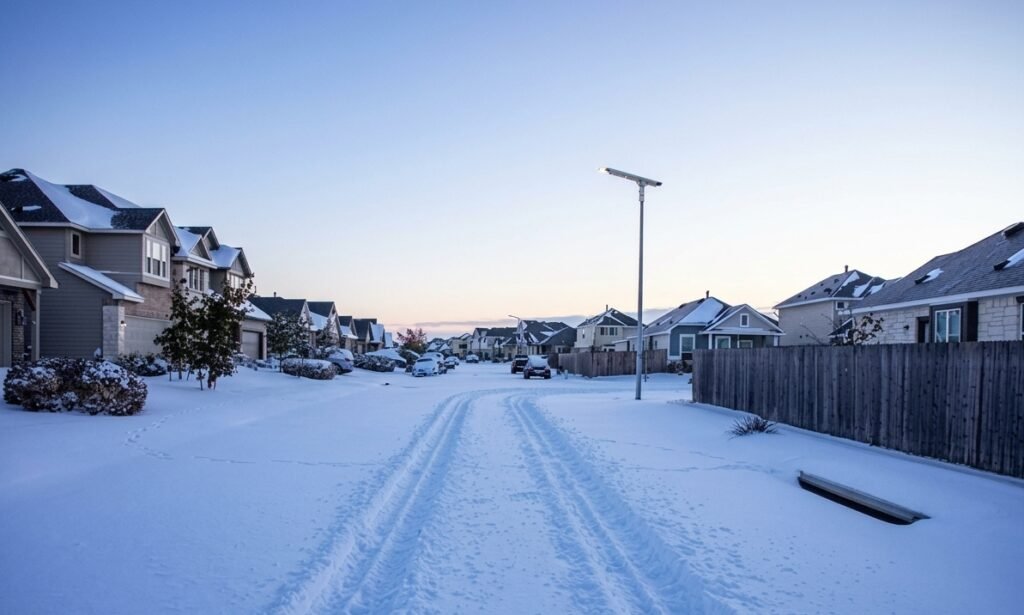
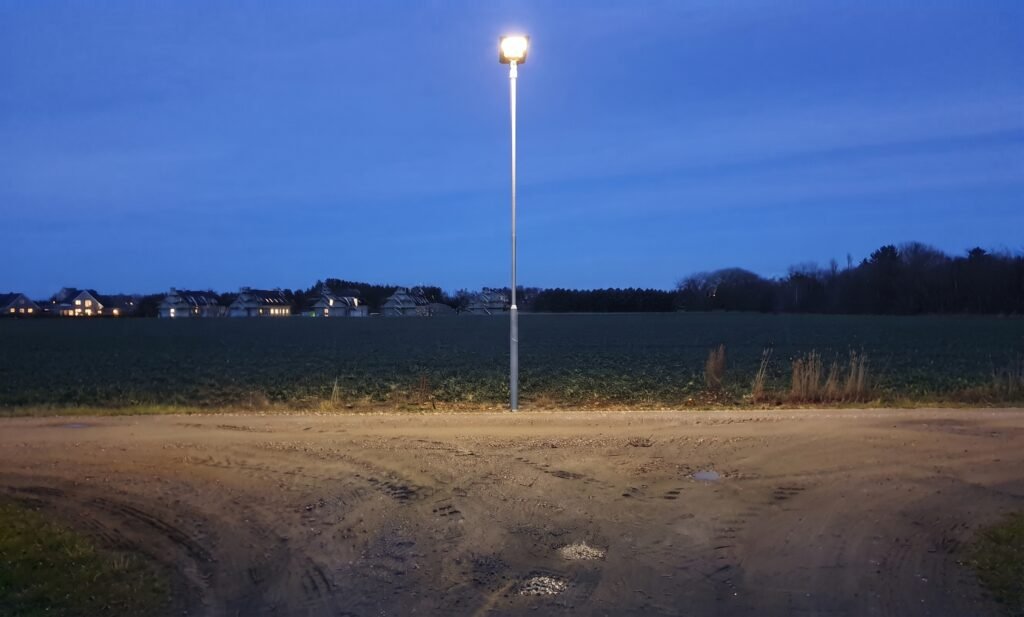
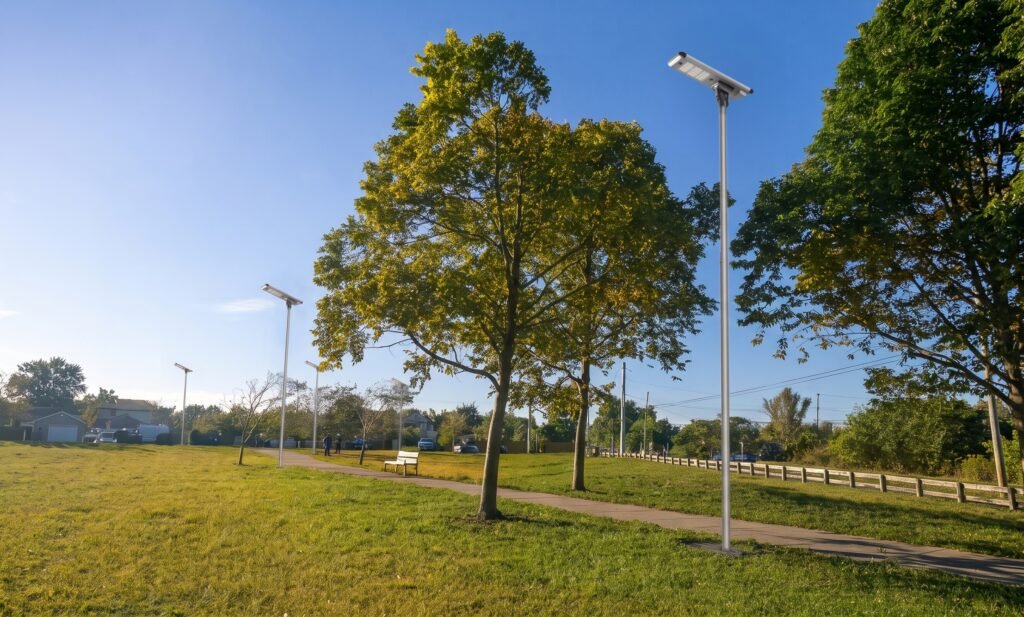
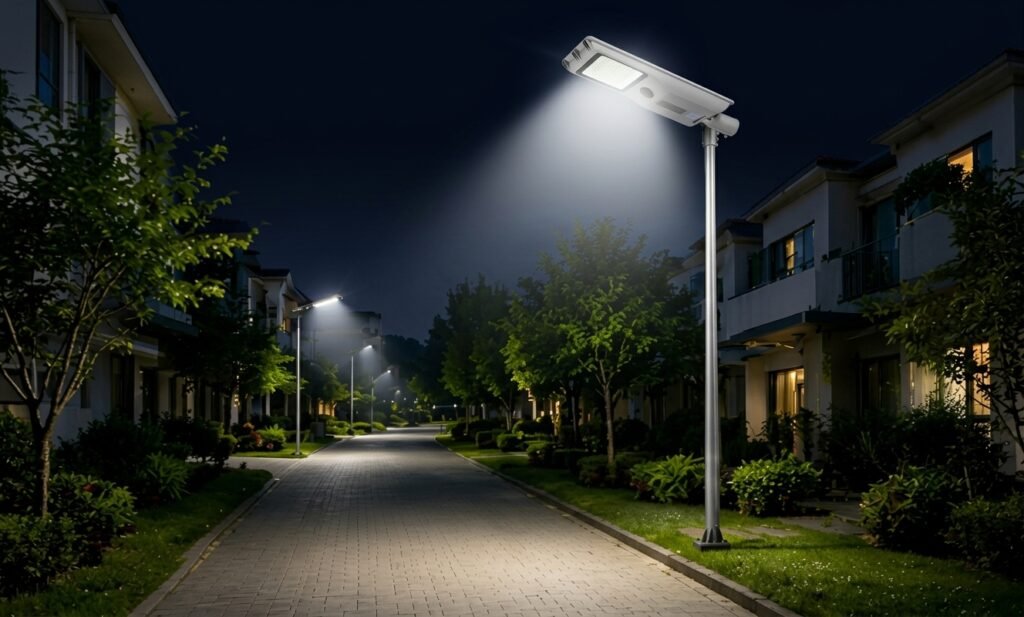
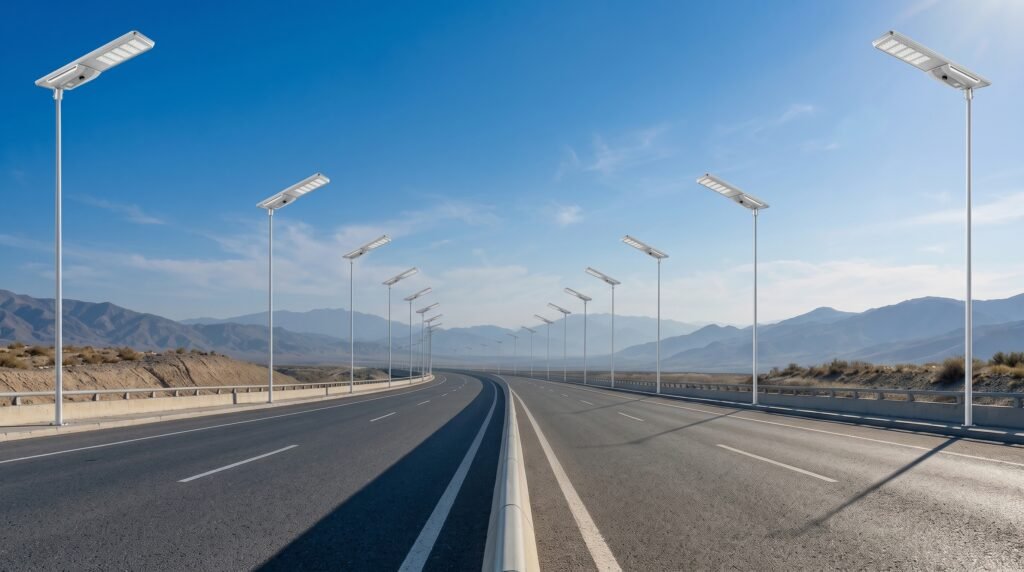
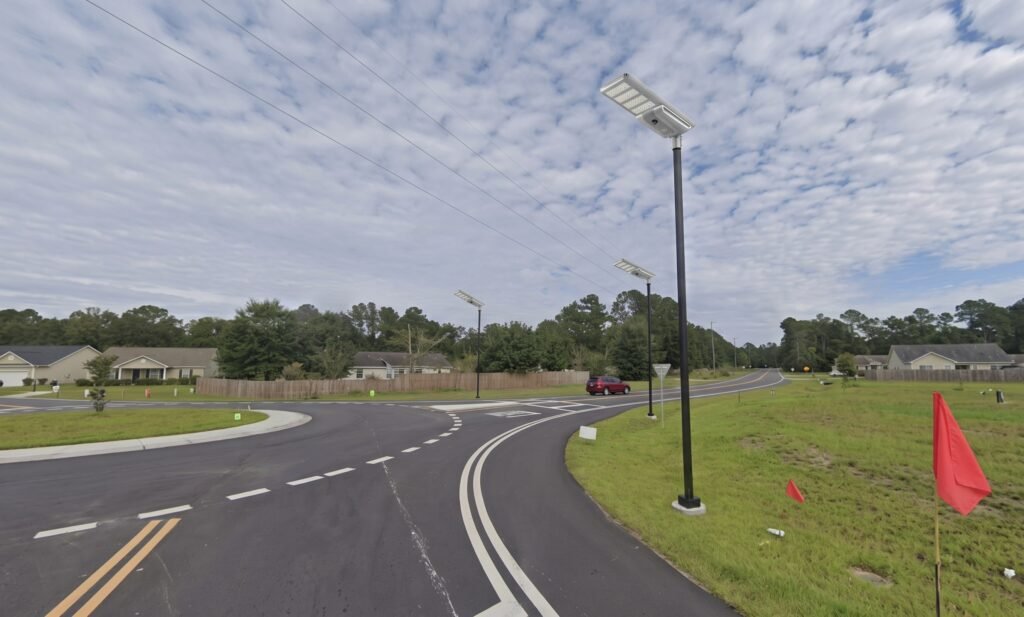
A solar street light works perfectly through summer, then starts switching off at midnight during the rainy season. Nine times out of ten, the battery isn’t dead and the LED isn’t broken — the controller simply doesn’t know how much energy the panel actually collected during the day.
The Root Cause: Brightness Is Set, Not Budgeted
Traditional controllers switch the light on at a fixed brightness and protect the battery only by voltage. On a cloudy or rainy day, the panel harvests only a fraction of its normal energy, the battery ends the day partially charged, and the controller faces a false choice:
- Keep full brightness until the low-voltage cutoff trips — the light dies at 1 a.m.
- Or cut power early to protect the battery — the street goes dark early.
Either way, the road loses light at night. That is the exact failure users complain about.
The Fix: Generation-Aware Adaptive Dimming (Dynamic Power Regulation)
Modern all-in-one controllers replace “fixed brightness” with “energy budgeting”:
- During the day, the controller continuously records how much energy the PV panel actually generates (daily generation statistics).
- At night, it distributes that stored energy across the whole night and automatically matches the LED output power.
- Energy plentiful (sunny day, full battery) → full brightness.
- Energy short (several rainy days, partial battery) → brightness auto-reduces (e.g., to 40–60%), but the light stays ON for the entire night.
This feature goes by several names in the industry: dynamic power regulation, generation-aware dimming, intelligent energy balancing, or rainy-day power reduction. The priority order is simple: all-night lighting comes before full brightness.
⚠️ The Critical Distinction: Not Every MPPT Can Dim
An ordinary MPPT charge controller only performs PV tracking and battery charging. It has no LED constant-current driver, so it physically cannot adjust LED brightness. Adaptive dimming requires an MPPT + boost constant-current all-in-one street light controller — the charging stage and the LED driving stage in a single unit. This is why many products sold as “MPPT” simply cannot do what this article describes.
Which Brands Actually Support It
International Brands
| Brand | Adaptive Dimming | Notes |
|---|---|---|
| Phocos (Germany) | ✅ Yes | CIS-N-LED series: built-in SOC (battery state) judgment + daily generation estimation, adaptive power reduction. Won’t switch off in rain — it dims. Mature algorithm; the most widely used reference in overseas street-lighting projects. |
| Victron Energy | ❌ No | General energy-storage MPPT, no LED constant-current driver. Would need an external LED driver + PLC logic — high cost, rarely used in integrated solar street lights. |
| Morningstar | ❌ No | Same as above: general MPPT, no LED driver, cannot dim directly. |
| Studer / OutBack / Schneider / Renogy / Blue Sky Energy | ❌ No | Mostly general energy-storage MPPT without built-in LED constant-current drive; direct dimming would require an entire additional drive/control system. |
Chinese Brands (All-in-One MPPT + Boost Constant-Current Street Light Controllers)
| Brand | Adaptive Dimming | Notes |
| SRNE | ✅ Full | “Generation–load linkage” mode: counts daily PV charging energy and auto-matches night output power; dims automatically on cloudy/rainy days to prioritize all-night lighting. Also compatible with classic SOC/voltage mode. The feature can be toggled via Bluetooth APP. |
| Remote Power | ✅ Yes | Intelligent energy-balancing mode: collects daytime generation and dynamically adjusts night output power; commonly used in municipal projects specifically to prevent lights going out; supports 2.4G remote configuration. |
| Lingyang | ✅ Yes | Rainy-day adaptive power-reduction algorithm with dual judgment (battery voltage + daily generation) to avoid the misjudgment of voltage-only logic. |
| EPEVER | ⚠️ Model-dependent | Split MPPT versions (e.g., Tracer series): no LED dimming, voltage-based protection only. All-in-one street light models: yes, support generation-aware adaptive dimming. |
Selection Checklist — How to Avoid the “Dark Street” Problem
- Confirm it is an all-in-one MPPT + boost constant-current controller, not a charge-only MPPT.
- Ask what the dimming logic is based on: actual daily generation statistics (generation–load linkage / energy budget) is the level that truly prevents midnight blackouts; voltage-only logic is not enough.
- Check how you configure it: Bluetooth APP, 2.4G remote, or NB-IoT management platform.
- Ask for rainy-day behavior in the datasheet: gradual dimming vs. hard cutoff.
- For overseas projects, prefer products with field track records — Phocos and the leading Chinese all-in-one makers are the usual reference points.
Conclusion
Generation-aware adaptive dimming turns a solar street light from an on/off device into a self-budgeting one: it matches night output to the energy the sun actually provided, so after a week of rain the road still has light — just softer. When you specify controllers, choose integrated MPPT + LED-driver units with true generation tracking. That single decision separates a reliable project from one with dark streets.